
What Have We Done?
on Kamigawa and the Horror of Violence

Another month, another happy announcement: Hipsters of the Coast published the second in a series of articles by me, titled “Sage’s Reverie” (still proud of the title). The article, “Finding Place in the Infinite: Land Design in Edge of Eternities,” is concerned with representations of land, space, and what it means to make the unfamiliar familiar. Give it a read!
It’s a curious fact of high fantasy that the genre seems built to grapple with immense suffering.
Think about what constitutes the “action” of most high-fantasy stories. The swordfight; the melee; the magical duel; the war; the apocalypse. Of course, existential pain isn’t exactly peppy—so in high fantasy stories, this kind of violence is more often aesthetic than agonizing; the battle for the end of the world, and all the implied therein, is where we find the cool battle scene, the power of heroism, and, in games like Magic, the thrill of play.
I don’t say all this as tut-tut moralizing. I don’t believe that fantasy violence is congruent with real violence. I love martial arts films and Dungeons and Dragons; I know The Legend of Zelda is not a snuff game; I don’t believe that Magic will make me go out and attack someone on the street. All these works are fantastical; they are more symbolic than literal. When I play Magic, I know that when I say “Stitcher’s Supplier dies,” I’m referring to a game piece and not a real living thing.
And yet this is precisely why it’s so interesting to see moments when Magic’s storytelling and worldbuilding lean into the visceral horror of violence—the Phyrexian Invasion and War of the Spark and the Summist-Monoist conflict in Edge of Eternities strive not just to be symbolical warfare but to evoke a kind of visceral, gritty pain in their imagery and narratives.
We should be interested, for this reason, in the way that Magic’s worldbuilding deals with the experience of calamity. When does it emphasize the essentially unreal character of its own violence, leaning into mythology or cartoonlike conflict, and when does it want to draw out the human consequences? And what can we do with that?
To answer these questions, I invite you to take a trip with me through the flavor text of the 2004-2005 Kamigawa block.
Mythology, History, Agony
As I suggest above, any question about Magic and suffering is essentially related to symbol and mythology.
This shouldn’t be entirely surprising. The founding texts of high fantasy, chief among them The Lord of the Rings, emerged in dialogue with cultural and national mythologies. Such mythologies are replete with battle, war, apocalypse, and rebirth: the Finnish Kalevala, the Norse Aesir-Vanir War and Ragnarök, the Hebrew Bible’s Exodus and Exile, the Christian tradition’s Revelation and the Milton-penned-biblical-fan-fiction Paradise Lost’s War in Heaven, and the granddaddy of all mythic conflicts, the Trojan War.
These narratives’ dramatic structure informs high fantasy’s structure. A whole host of high fantasy stories begin or end (or both) with a capital-b, capital-c Big Calamity: cosmic ruptures, apocalypses, wars-to-end-all-wars, etc. etc. etc.
This chronotope has cosmic significance. The function of myth, as the philosopher Paul Ricoeur suggests, is to articulate our existential conditions and then project them back onto the world: the story of human torment, and perhaps triumph, becomes the story of the universe.
That Kamigawa block is occupied with mythology is no secret. The world of Kamigawa was explicitly designed to dialogue with the Shinto spirituality of feudal Japan. As former Magic Creative Director Brady Dommermuth writes, the set’s guiding principle was “Shinto gone wrong,” and Rei Nakazawa has emphasized that the flavor of Kamigawa is meant to evoke the impression of a world gone wrong. Indeed, Sam of Rhystic Studies has suggested that one of Kamigawa block’s greatest storytelling foibles is that it projects cosmic conflict onto Shinto religion, which doesn’t include such conflicts.
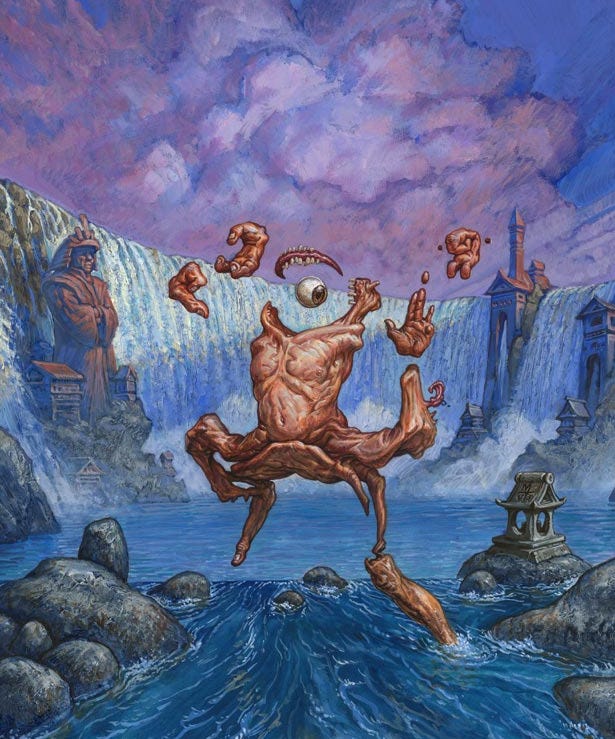
Still, what’s noteworthy to me is the extent to which Kamigawa block inhabits the card reader—and the player, if they so choose—in the inordinate agony that is necessarily present to, but never made explicit in, most mythological conflicts. As “Kami of Twisted Reflection” has it:
Its form reflected humanity as it stood during the Kami War: disjointed, confused, and incomplete.
And how does Kamigawa “reflect[]” this “disjointed, confused, and incomplete” humanity? One way is through mythology’s earthly counterpart, history. A recurring flavor motif is the records that humankind keeps during the war—but rather than spin the fighting as Iliadesque heroism, these records, sometimes earnestly and sometimes by way of irony, evoke the Kami War’s tide of terror.
Some of the most frequent refrains in Kamigawa block flavor text are to fictive books: Great Battles of Kamigawa (which is mentioned 10 times), Observations of the Kami War (15 times), and History of Kamigawa (16 times)—all clearly meant to evoke the sorts of national-mythic histories in which great conflicts are recorded. Yet though Great Battles, Observations, and History make occasional references to heroic triumphs (like “Rend Spirit” and “Eiganjo Free Riders”), the bulk of their records evoke the obscene misery perpetrated during the war.
In some cases, the poetic imagery we might associate with an epic myth becomes the site of intense horror.
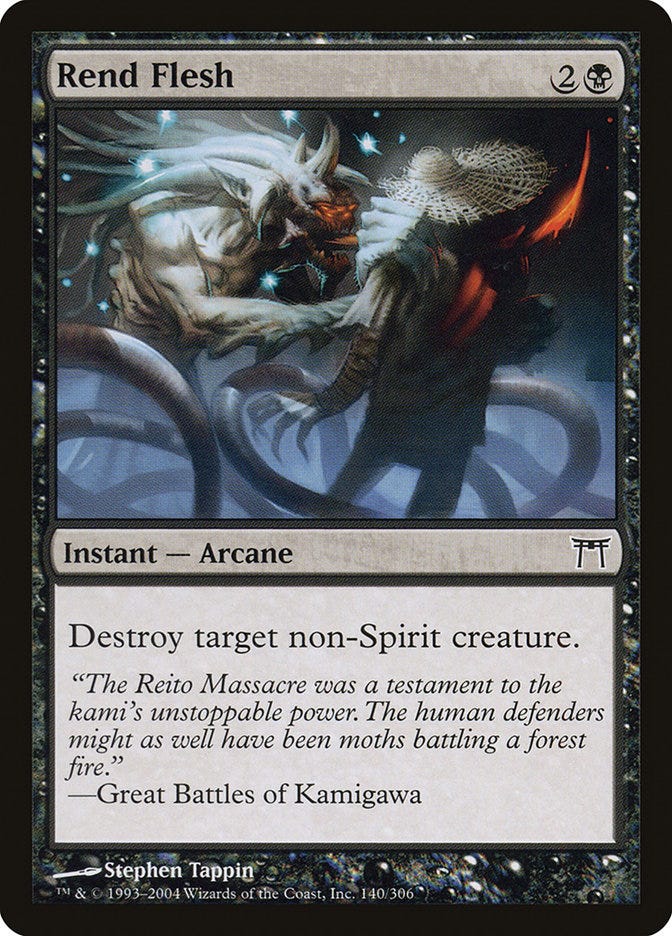
“Rend Flesh” (whose beautiful Stephen Tappin illustration, prescient of the kind of shadow-drenched cinematic imagery that would become common in Magic in the coming decades, depicts a monstrous kami impaling a limp human form with its tongue) reads “The Reito Massacre was a testament to the kami’s unstoppable power. The human defenders might as well have been moths battling a forest fire.” The title Great Battles can only be ironic.
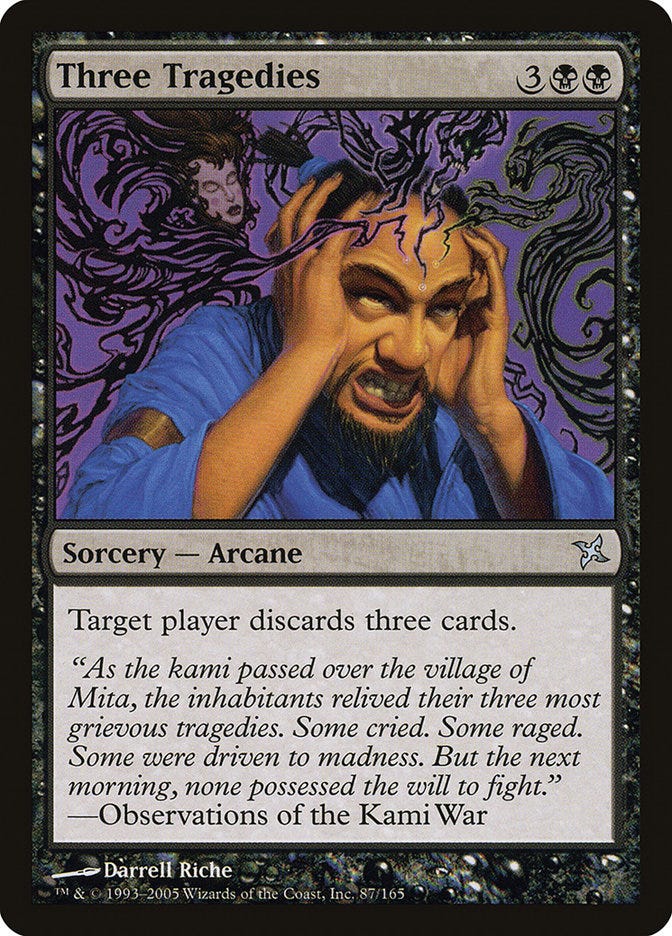
“Three Tragedies” boasts not only a wonderful illustration but a haunting micro-story in its flavor. Darrell Riche’s art depicts a man gnashing his teeth as splinters of black lightning arc toward his forehead; it seems perhaps like an annoyance, but the flavor text says otherwise.
“As the kami passed over the village of Mita, the inhabitants relived their three most grievous tragedies. Some cried. Some raged. Some were driven to madness. But the next morning, none possessed the will to fight.”
Striking here is that the flavor text adopts and then inverts the numeric structure of many folk tales and myths. Where, in other stories, fixed numeracy yields whimsy (three bears, three beds) or mythic progression (twelve labors), this is a threeness of horror: three tragedies; three parallel-structured agonies (“Some cried. Some raged. Some were driven to madness”). And at the end, one conclusion: despair, defeat.
Mythic aesthetics here are turned inside-out. They take the language through which the player might articulate heroism and instead locate in them horror.
The flavor text attributed to The History of Kamigawa, for its part, often appears more like topic sentences in the subsection of a book.


“The Kami War drove many members of Konda’s court insane. As their spiritual world turned against them, so too did their minds turn from reality.” (“Hair-Strung Koto”)
“Owls filled the skies during the Kami War, harbingers of darker times to come.” (“Ebony Owl Netsuke”)
“Early in his reign, Konda fell ill. His head burned with fever, and he saw visions of his future. In them, he saw a spirit-child, and, in that child’s eyes, a way to make his empire last forever.” (“Mannichi, the Fevered Dream”)
The purposefully open-ended structure of these lines couples with their unsettling imagery; the result is a sort of stomach-turning affect, a sense that something horrible is going to happen. Yet my favorite comes from “Scourge of Numai”: “Where a once-proud human city stood, only the ruins of Numai remain, deep amid rotting bamboo and plagued by oni.” This excerpt is particularly striking in that it tugs on the reader: Numai is still in ruins, it remains enshrouded in rot and plague; it belongs to the now, to you.
The histories of Kamigawa are, in short, not like those histories of Odysseus or Beowulf, in which eventual triumph exonerates momentary sufferings. These are pains that last, pains that radiate even into the hands of you, who hold the card.
What Have You Done?
Other flavor text in the Kamigawa block uses records ironically, to bitter and gut-wrenching effect.
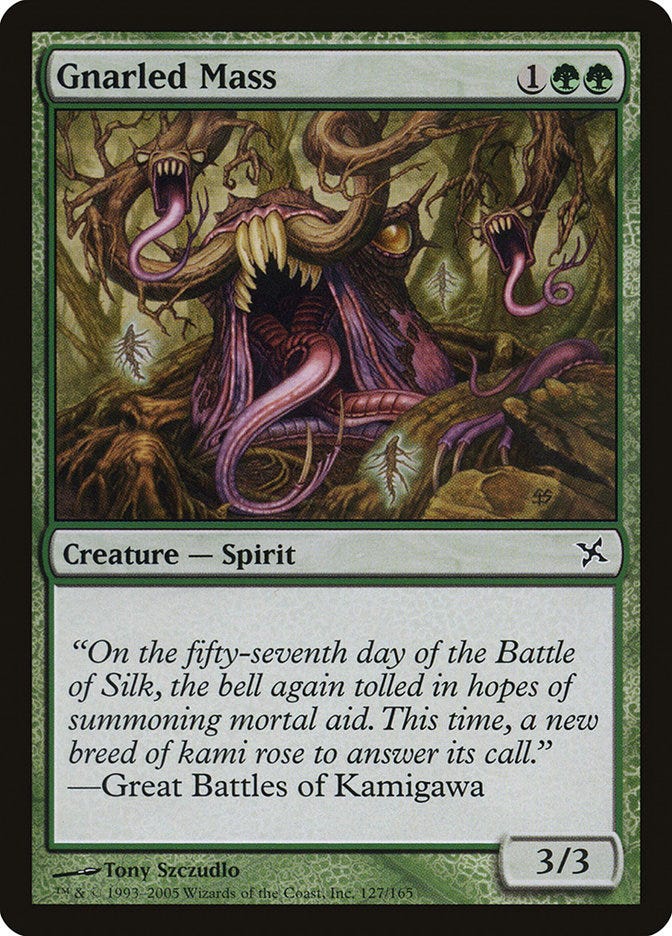
Great Battles reports that “On the fifty-seventh day of the Battle of Silk, the bell again tolled in hopes of summoning mortal aid. This time, a new breed of kami rose to answer its call.” For a moment, a flare of hope: perhaps some kami have defected to fight alongside humankind! But, as we look back up at the card name and art, we realize the terrible double-meaning: the kami have not risen as succorous saviors, but as a monstrous “Gnarled Mass.”
Indeed, the same morose irony plays out in many of Kamigawa block’s cards. The flavor text on “Ore Gorger” comprises a message from a group of soldiers to one General Takeno; they write, “We’ve stumbled upon a network of caves not on our maps. We can only hope it is safe to spend the night.” Yet their name—“Lost Battalion”—and the card’s art, which depicts an unsettling protozoic creature, defy such hopes.
Perhaps the most effective ironic record appears on “Kami of Fire’s Road.” “I can hear the shamans chanting in the hills,” an anonymous writer records. “They say their magic will protect us from the kami, that our gold has bought our safety. But no one sleeps soundly tonight.”
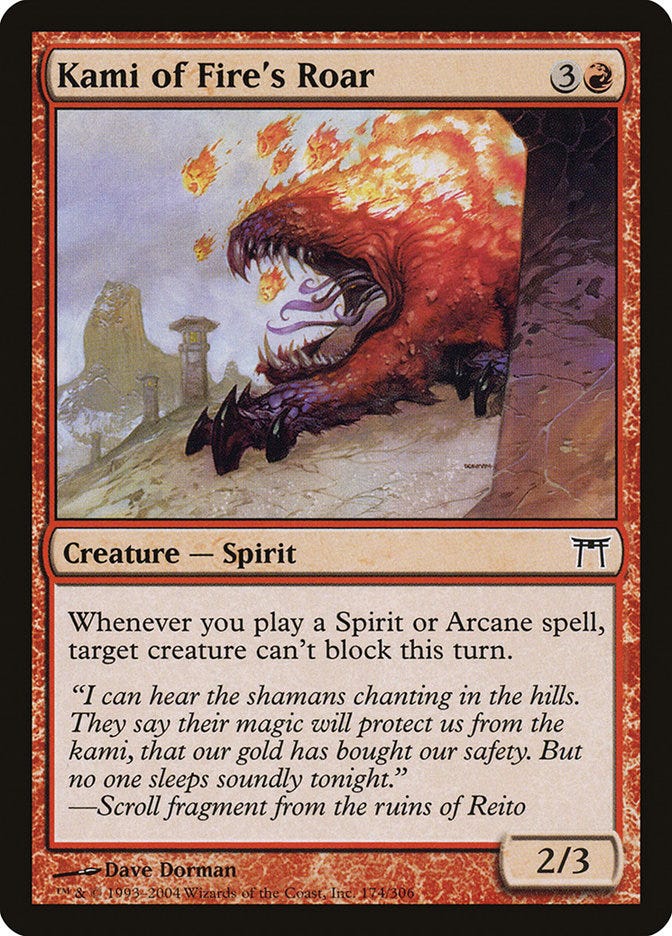
The attribution: “Scroll fragment from the ruins of Reito.”
As before, a profession of hope is made tragic by retrospection: Dave Dorman’s art depicts a titular kami coursing with crimson flame, and the explicitly fragmentary attribution strips away even the writer’s identity. They have been burned away by the time we reach them.
But what makes this flavor stronger than its kin is its explicit despair. This is not the foolhardy confidence of “ha-ha get it?” flavor text like “Bronze Bombshell” or “Dragon Mage” (or nearly 50 other Magic cards). Rather, the scroll fragment’s writer knows, deep down, that they won’t survive the night—and we’re made to bear witness to their hopelessness.
The power here is precisely in the admission of frailty, the sense of inevitability it encodes. And this inevitability radiates out to the frame of the game of Magic itself: after all, didn’t you put “Kami of Fire’s Road” in your deck because you wanted to use it? Aren’t you going to play it when you get the chance? Aren’t you going to visit the same fate upon your opponents’ creatures as the Kami visited upon the fragment’s writer?
Let’s draw back—it’s tempting to get too literal, isn’t it? In truth, I don’t think that it’s an immoral act to pick or play “Kami of Fire’s Road.” It’s a game piece, after all; the harm isn’t real.
And in fact, this should make it all the more interesting that the card, indeed all the cards we’ve seen here, wants us to think about visceral violence.
Psychic Wounds
To be sure, Kamigawa’s grotesque anguish goes beyond its in-universe histories. Such is evident in the visually arresting body horror that appears over and over within the set’s card frames—from the dark striations of Tsutomu Kawade’s “Dripping-Tongue Zubera” to the mute fear of Michael Sutfin’s aptly named “Distress.”
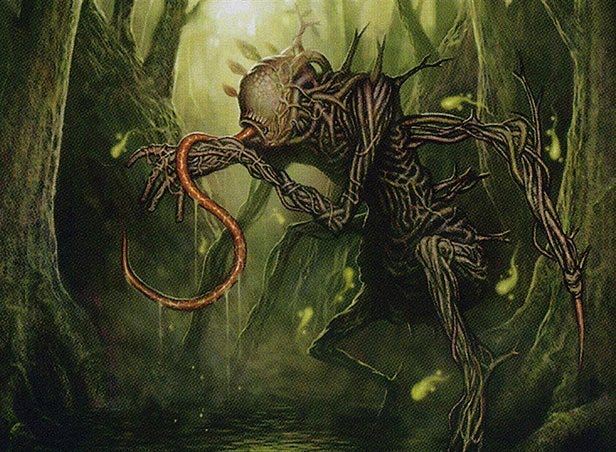
Yet even more powerful, in my view, is the way that Kamigawa block’s flavor text draws us to moments when physical and spiritual distress blur together.


In many cases, this suffering comes in the form of lost faith. The “Honden” cycle, for example, is structured around spiritual shrines visiting torment upon their adherents—“To the suffering of all,” as the cycle’s refrain goes. In “Kagemaro’s Clutch,” a brave warrior is not only suffocated by a deadly miasma—but also finds himself alone. And in two of the most famously moving flavor texts in Magic (and two of my personal favorites), physical threat opens onto unspeakable despair:
“It seemed an easy thing, to step into the nothingness, to fall, to die. But then, for an instant, I saw it, eyes filled with endless sorrow, and I turned back to face my pain.” —Snow-Fur, kitsune poet (“Guardian of Solitude”)
“I saw them once, when I was a child. They led me to my parents’ arms when I was lost. Why have they abandoned me now? Why won’t they take me home again?” —Unnamed beggar
In all these cases, the physicality of the Kami War—burning fire being turned on human forms, an invitation to self-destruction, a spate lost in the wilderness—becomes the locus of psychic trauma, bereftness and sorrow and bottomless agony. Certainly, it’s true that many have died in this war—but the survivors fare little better.
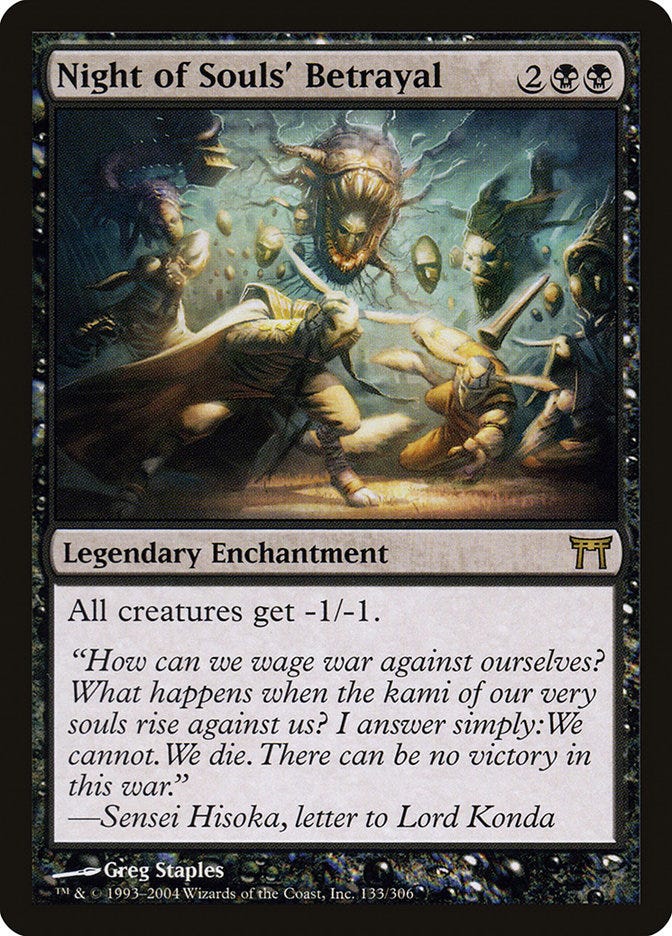
A similar motif in Kamigawa is self-betrayal, the echoing of obscene physical suffering with perversions of the self. It’s a fitting theme, given that the Kami War is essentially based on the world splitting itself in two; as the flavor text for “Night of Souls’ Betrayal” (below Greg Staples’ mortifying illustration) reads:
“How can we wage war against ourselves? What happens when the kami of our very souls rise against us? I answer simply: We cannot. We die. There can be no victory in this war.”
Because the kami belong not just to the external world but to humans themselves, the Kami War is necessarily one of self-consuming self-destruction; nobody can win, and yet the impulse to fight rages on.
This affliction spreads to everyone in Kamigawa. For “Battle-Mad Ronin” (Wayne England), the very bloodthirst that might have made him a “hero” caused him to “st[rike] down my captain in the heat of battle.” “Cursed Ronin” (Carl Critchlow), similarly, seethes with torturous darkness, his white eyes beaming out fury and remorse alike: “‘You are fortunate, my enemy. You have paid the price but once. I never stop paying.’”
As it turns out, guilt and rage and betrayal plague humans and Kami alike. In “Gaze of Adamaro,” the titular kami finds that “Wherever it looked, it saw destruction—the wake of its own gaze.” In the choreography of Adamaro’s existence, to be is to destroy, to find yourself in the wreckage of your own life.
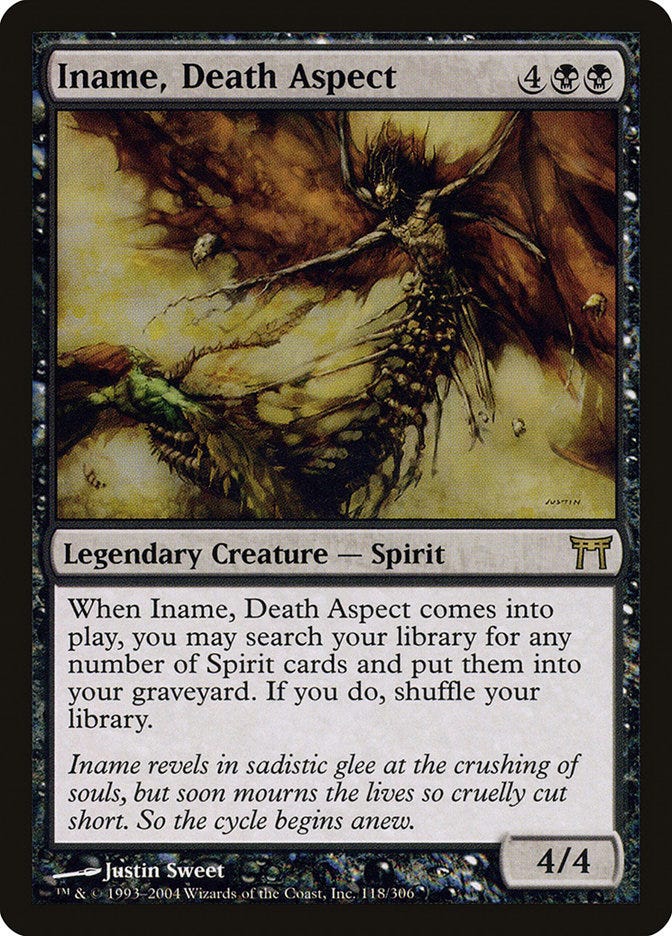
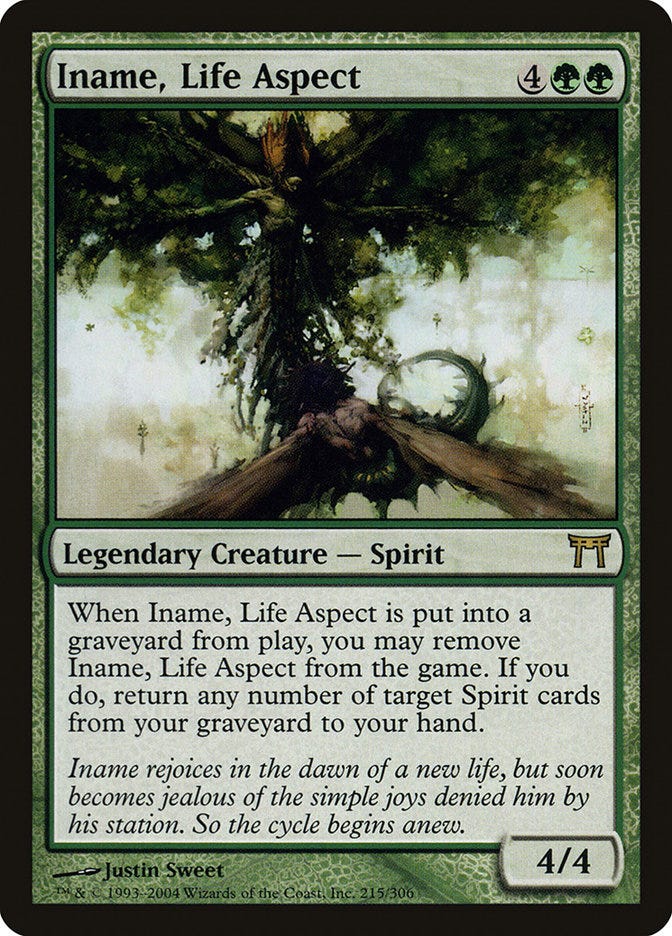
Iname, the namesake of both “Iname, Life Aspect” (Justin Sweet) and “Iname, Death Aspect” (Justin Sweet), is trapped in a similar calamitous cycle. The cards’ parallel flavor texts create a linguistic and existential trap:
Iname revels in sadistic glee at the crushing of souls, but soon mourns the lives so cruelly cut short. So the cycle begins anew.
Iname rejoices in the dawn of a new life, but soon becomes jealous of the simple joys denied him by his station. So the cycle begins anew.
There is no beginning to this cycle—or rather, it is always beginning, at death and at life and at death and—so on, a perpetual turning gyre between compassion and jealousy and sadism and melancholy. The suffering that Iname embodies is that of mourning the destruction that you, yourself, author—and cannot help but author again.
If Kamigawa block’s histories turn our mythic vocabularies against us, here its flavor text throws our psychic vocabularies in our face. There seems to be no forgiveness or absolution or transcendence to be found, only a compounding horror: the remorse for the pain that you birth and will never, it seems, stop birthing.
It should interest us, I think, that this motif appears in Magic, a card game so explicitly invested in cyclicality—the back-and-forth of turns, of the match, of the game session, of the weekly meetup, of the release cycle. These sorts of routines are comforting, but here, cyclicality becomes something dark and unsettling.
Should we happen to notice it, would we feel comfortable passing the turn and waiting for our next draw step?
What Are We Doing?
To be sure, “Kami of Fire’s Road” and “Iname” and “Three Tragedies” and their compatriots are not straightforward moral indictments; they’re complex aesthetic and ludic objects. They’re part of a game with a much more complex system of meanings than “you’re a bad person for playing a violent game.”
Even so, it strikes me that “Kami of Fire’s Road” and its historical compatriots are experimenting, in a subtle way, with what it means to tell a story in the format of a playing card game. They are asking whether, somehow, the player shouldn’t be involved in the melancholy of an in-game calamity, whether, indeed, we shouldn’t consider it our business.
This is hardly common in games, whether of the card, board, or video variety. Games that simulate war either do so from a cool remove or through heart-pumping immediacy; usually, when sorrow arrives, it’s quarantined from the player’s experience. In Mass Effect, I can come across audio logs recording a mad scientist’s gruesome fate—but that has only a tangential bearing on my own very cool, very fun mission of smoking a bunch of aliens.
The cards of Kamigawa block are different. They have the power to interrupt the otherwise-immersive reverie of a game session, to remind us of the complex ethical questions we might otherwise suspend. They ask us whether, somehow, violence—even when we don’t see it, even when it isn’t properly real—might actually involve us.
In short, they make us like “Reki, the History of Kamigawa,” an unassuming 3-mana 1/2 green creature with one of my most favorite stories in all of Magic.
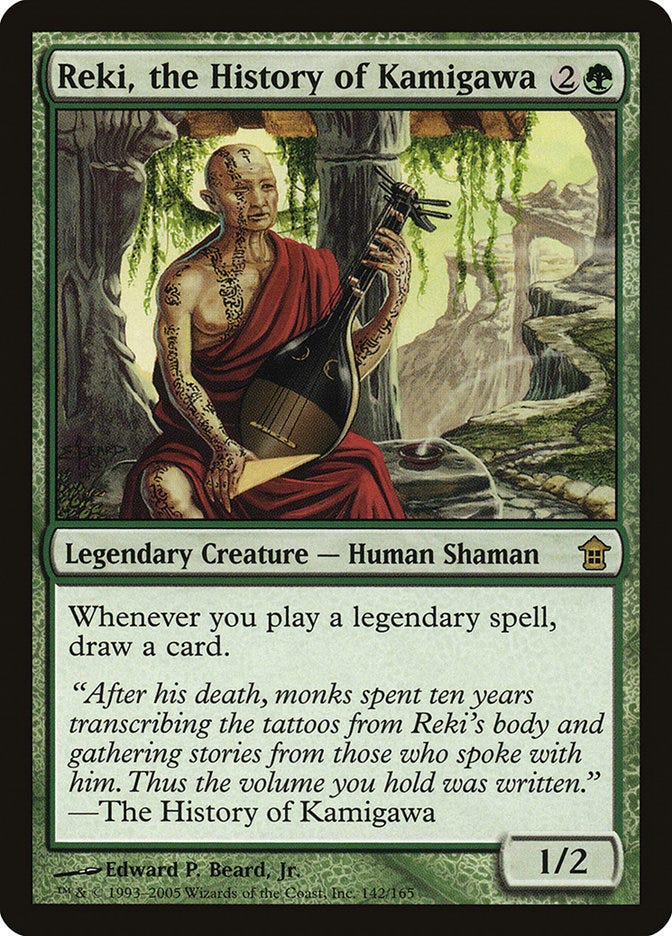
“After his death,” The History of Kamigawa records, “monks spent ten years transcribing the tattoos from Reki’s body and gathering stories from those who spoke with him. Thus the volume you hold was written.”
As it turns out, the annals of hope and despair and suffering and life we’ve been encountering on these pieces of cardboard—they all have, notionally, passed through the medium of the human body. The story we’ve heard, and that he “hold,” unimpeachably impressed itself upon physical life.
And so, too, does the dark history of Kamigawa propose to impress itself on us.